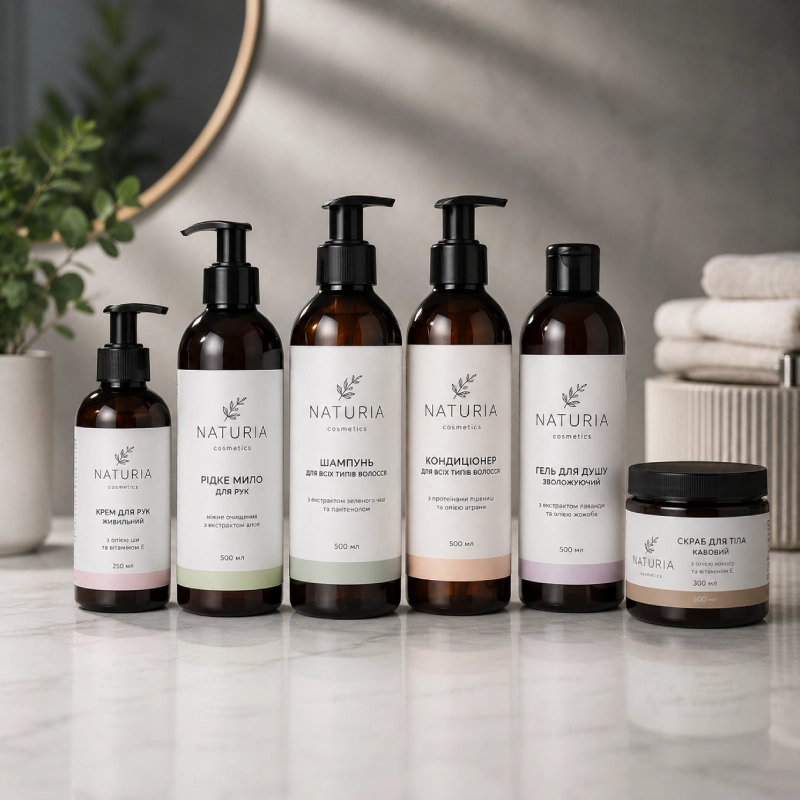
Handmade Cosmetic Labels: Paper, Film or Kraft
Labels for handmade cosmetics are chosen based on how the product will be stored and used. Creams, oils and shampoos come into contact with water and grease, so film is the better choice for them. Paper is better suited to dry products and packaging, while kraft highlights a natural formula. Beyond the material, the label has to fit all mandatory information and stay readable on a small container.
Cheat sheet: which material to choose for each product
This table will help you quickly choose the label material. Find your product in the first column: the second shows which label to order, and the third explains why.
| Product | Which label to choose | Why |
|---|---|---|
| Cream in a white jar | white film or clear film with color print | Film does not soak through or absorb cream. Color print on clear film is only clearly visible on a white container. |
| Cream or balm in a glass or dark jar | white film or clear film with black print | Transparent film can only be used on white packaging. On dark packaging, the print becomes invisible. |
| Shampoo, shower gel, body oil | white film | The bottle sits in the bathroom, so the label must withstand water and oil. |
| Perfume, premium line | silver film | The metallized base makes the product stand out among ordinary paper labels. |
| Packaged soap, bath bombs, bath salts | paper or kraft on the packaging | The label goes on dry packaging, not on the product itself. Kraft highlights a natural formula. |
| Gift set, box, sachet | paper or kraft | Water does not get on the packaging, and paper reproduces the colors of your artwork most accurately. |
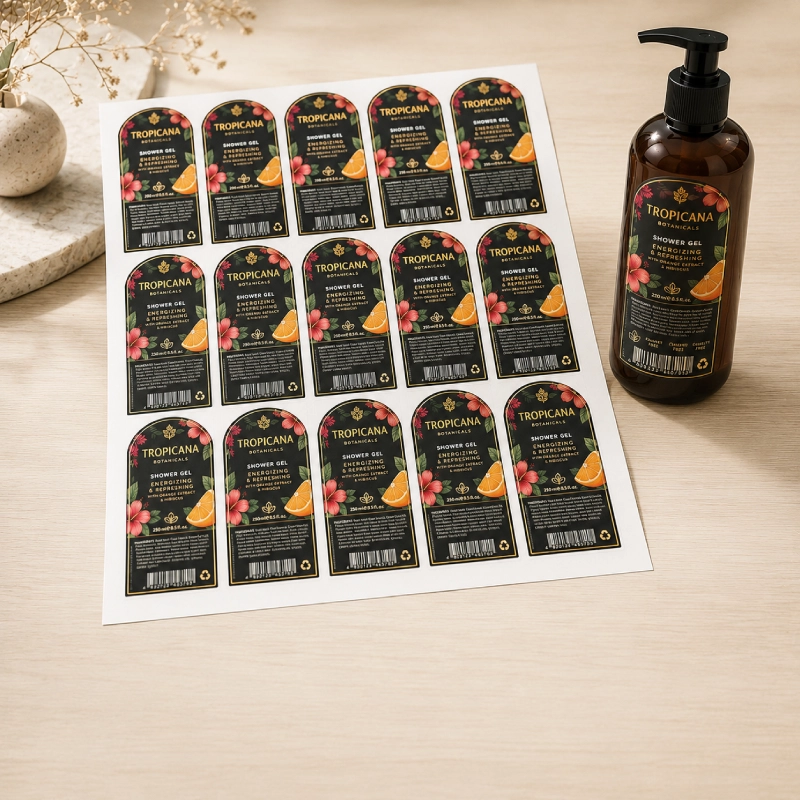
Self-adhesive paper: accurate color for dry products
Paper reproduces the colors of your artwork best, but it absorbs moisture and oil, and a stain on it stays forever. That is why its territory is boxes, sachets, seal stickers on lids and branded stickers on shipping packaging. Matte or gloss lamination protects the print from accidental splashes, but it does not make paper suitable for the bathroom.
Film: white, clear or silver
Film does not soak through or absorb grease, so it is the main material for products that come into contact with water.
White film
The most versatile option: on a white base, colors are as rich as on paper. It comes in gloss or matte, and with soft touch lamination the surface becomes velvety to the touch.
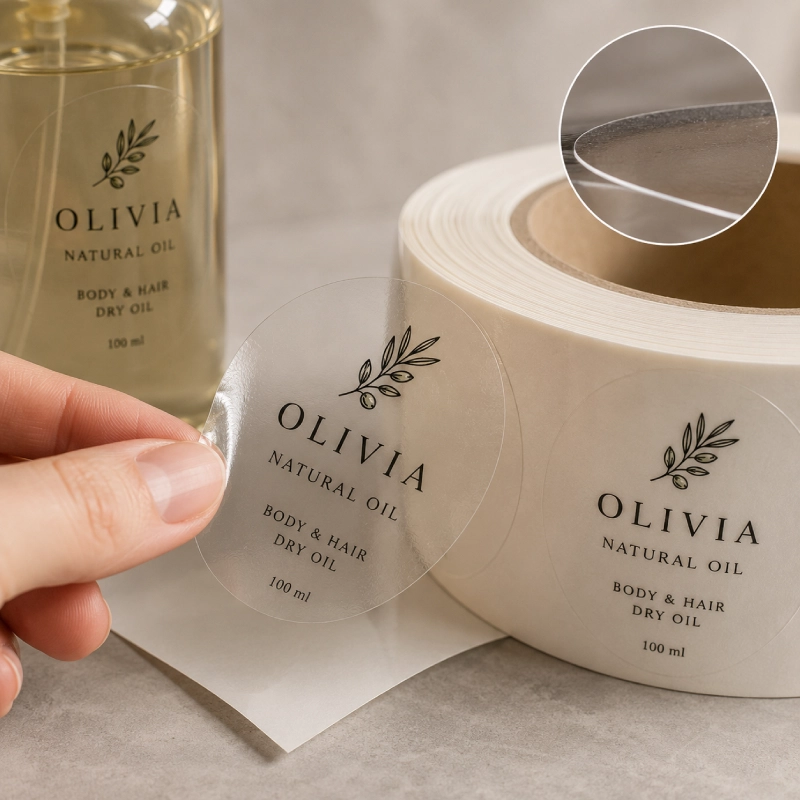
Clear film
Creates the effect of text printed directly on the container. Printing is done in CMYK without white ink, so a color design on clear film is only legible on white containers. On glass, dark and colored bottles, black print is used: it looks clean and stays high-contrast.
Silver film
A metallized base that instantly makes perfumes and premium lines stand out among paper labels.
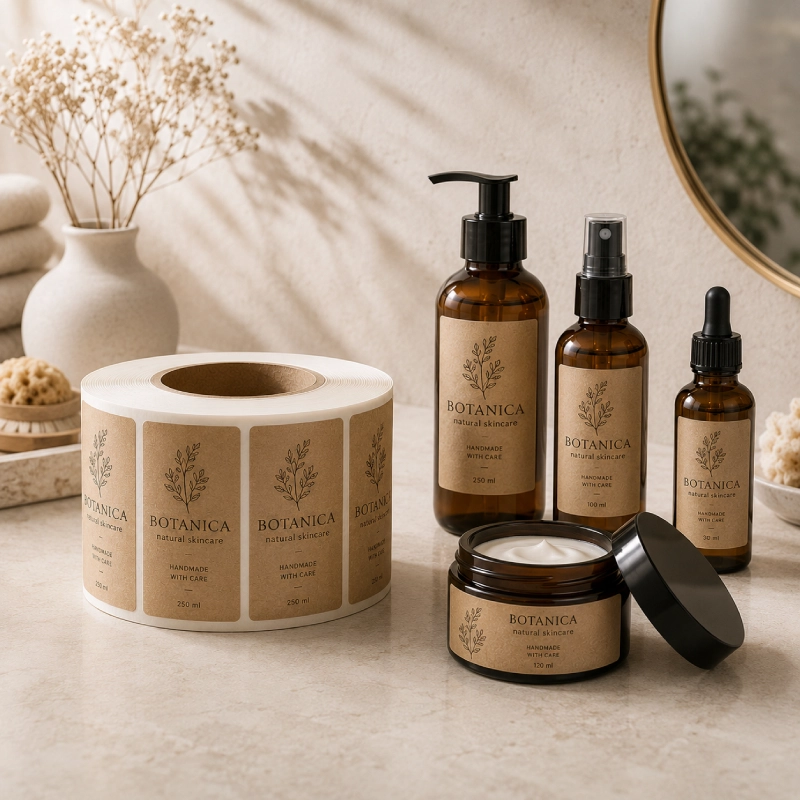
Kraft: an eco look with limitations
The brown base with its warm texture is associated with natural ingredients and handmade work. Colors on it look muted, and light or thin fonts get lost, so designs for kraft are made dark and high-contrast. Kraft absorbs moisture, which means on a bottle that sits in the shower it will quickly lose its look.
What must be on a cosmetic label
Ukraine has a Technical Regulation on Cosmetic Products, approved by Cabinet of Ministers Resolution No. 65 and based on the European Regulation 1223/2009. It also applies to small producers, so before printing check that the label includes:
- the name and address of the manufacturer or other responsible person;
- weight or volume;
- the expiry date or the open jar symbol with the number of months of use after opening;
- the batch number;
- the product’s function, if it is not clear from the name;
- precautions for use;
- the list of ingredients.
Labeling for the Ukrainian market is provided in Ukrainian. Before launching a print run, check the list against the current version of the regulation.
Cosmetic label design: how to fit everything and keep the style
- Size for the container. Measure the height of the usable area and the circumference. On a round jar the edges of the label should not meet, so leave a gap of a few millimeters. On tapered jars a rectangle will wrinkle into waves, so you need an arc-shaped label.
- Hierarchy. The front only needs the brand, product name and volume. Ingredients, storage conditions and the batch number go on the back or on a second label.
- Readability. Set the ingredients in a font no smaller than 6 pt and without thin decorative styles.
- Bleed and corners. Extend the background 2 mm past the cut line. Round the corners by at least 1-2 mm: such a label is harder to pick at and peel off.
- Artwork. We accept PDF, AI and CDR files. If you do not have artwork yet, our design studio will create it.
Before the print run, apply a few test labels to the real container and use it for a few days: this shows whether the edges lift and whether the text is readable.
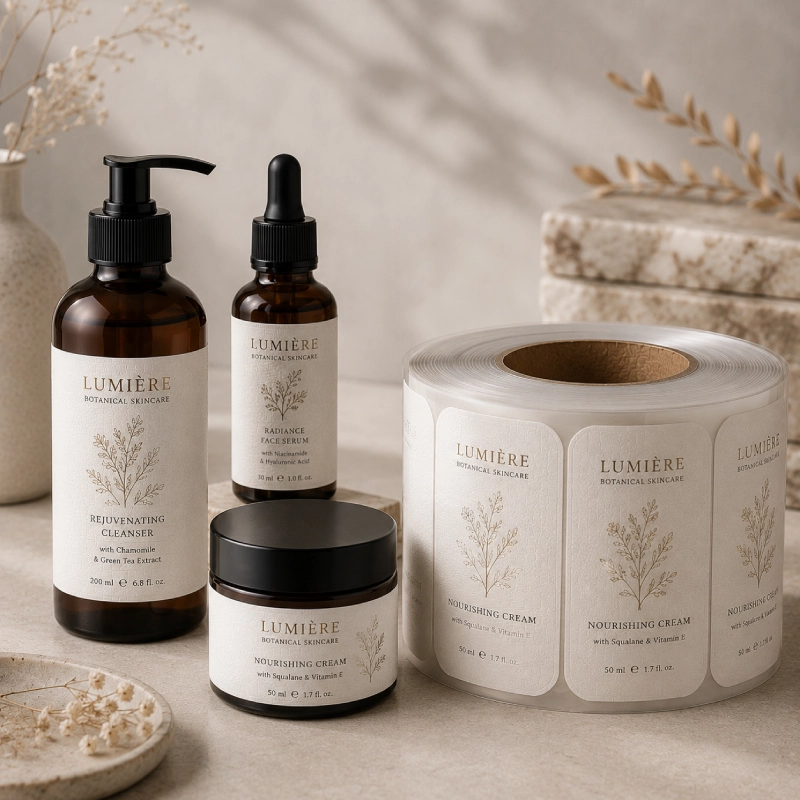
Sheets or rolls
Sheet labels are convenient at the start: a 320×450 mm print area, any shape thanks to contour cutting, and designs for different products or scents can share one sheet. If there is no production queue, urgent production is possible.
Once an order grows to about 20 sheets, it is more cost-effective to switch to roll labels: from 10 linear meters, production from 1 business day, manual or machine application. Roll labels can be finished with foil stamping and a QR code. Other formats are available in the stickers section.
Aladdin Print has been in business since 2007. We will help you choose the right material for your container and prepare your artwork, and we ship finished labels across Ukraine via Nova Poshta or hand them over at our offices in Kharkiv and Kyiv.
Frequently asked questions
How do I print batch numbers on labels?
Numbering is available for roll labels: each batch gets its own number right during printing, with no need to write it in by hand.
How do I keep a label from peeling off an oil bottle?
Choose film and apply the label to a clean, dry container before filling, while there is no oil residue on the surface.
What if the ingredient list does not fit on the label?
For small containers, the ingredient list may be moved to an insert, the packaging or a tag, with a corresponding reference left on the label.