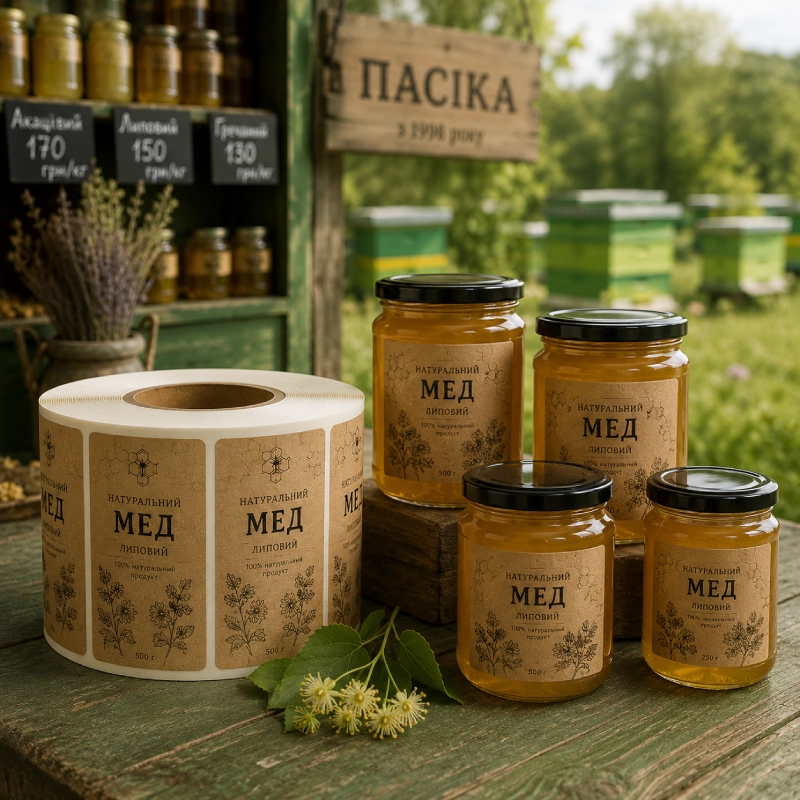
Honey Jar Labels and Labels for Preserves: Which Material Withstands Moisture
Honey jar labels and labels for preserves work best when printed on film, white or clear. Film doesn’t mind moisture, condensation or washing and won’t wrinkle in a cellar or fridge. Paper and kraft jar labels look great, but without lamination they only suit dry storage. Aladdin Print prints labels for honey jars on sheets and on rolls, cut to any shape.
A familiar story: at the fair, a jar of honey looks perfect. A week later in the buyer’s kitchen, the label is covered in sticky stains, and after the cellar it has gone wavy. Buyers don’t think about label materials. They simply decide the product is “not quite right”. Here is how to avoid that.
What threatens a label on a jar
A label on a jar of honey or preserves lives in tougher conditions than it seems:
- Sticky drips. Honey runs down the neck, and the jar gets wiped with a damp cloth. Paper soaks up both water and honey.
- Condensation. Take a jar out of the cellar or fridge and it fogs up at once. Water collects right under the label.
- Warm water. Crystallized honey is often softened by standing the jar in warm water.
- Friction. Jars rub against each other in boxes during delivery, and print on unprotected paper wears off.
So for jars the key question isn’t “what looks nicer” but “what will survive these conditions”.
Jar label materials: what withstands moisture and what doesn’t
White film, gloss or matte
The most reliable option. It resists moisture, abrasion and temperature changes, so it works in both a cellar and a fridge. For gift editions you can add soft touch lamination, which makes the label feel velvety.
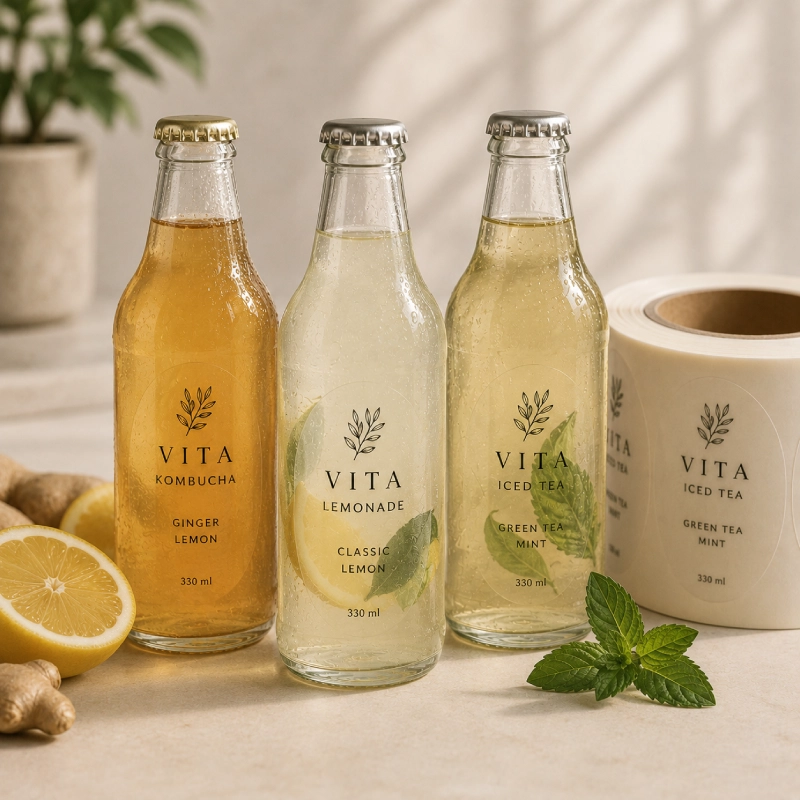
Clear film
Creates a “no label” look: the text seems printed straight onto the glass, and the honey shows through beautifully. The film is moisture-resistant and withstands heat up to +70 °C. An important design detail: it is printed without a white underlayer, meaning no white ink under the colour image. Light elements are barely visible against dark honey, so choose dark, contrasting colours for clear labels.
Kraft paper
A favourite with beekeepers and farmers: its warm texture says “natural product” at a glance. But kraft absorbs moisture, so kraft honey jar labels for sale should be laminated.
Self-adhesive paper
The most budget-friendly option for jars kept somewhere dry: souvenir sets, honey on a shop shelf. Without lamination it is not suitable for cellars, fridges or preserves.
Lamination, matte or gloss, protects any material from drips and friction. If you are unsure whether honey labels need it, the answer is almost always yes.
Which material suits your situation
- Honey for sale (fairs, shops, marketplaces). White film or laminated kraft: both will survive the journey and the buyer’s kitchen.
- Preserves in a cellar: jam, pickles, sauces. Film only. Paper won’t last long in a damp cellar.
- Corporate holiday gifts. Kraft or white film with soft touch, or clear film for a minimalist design. Honey in a branded jar is a popular gift for partners, and the label works as the company’s business card.
- Large volumes for shops and retail chains. Film on a roll, which can be applied automatically on a filling line.
Labels for honey jars: sheets or rolls
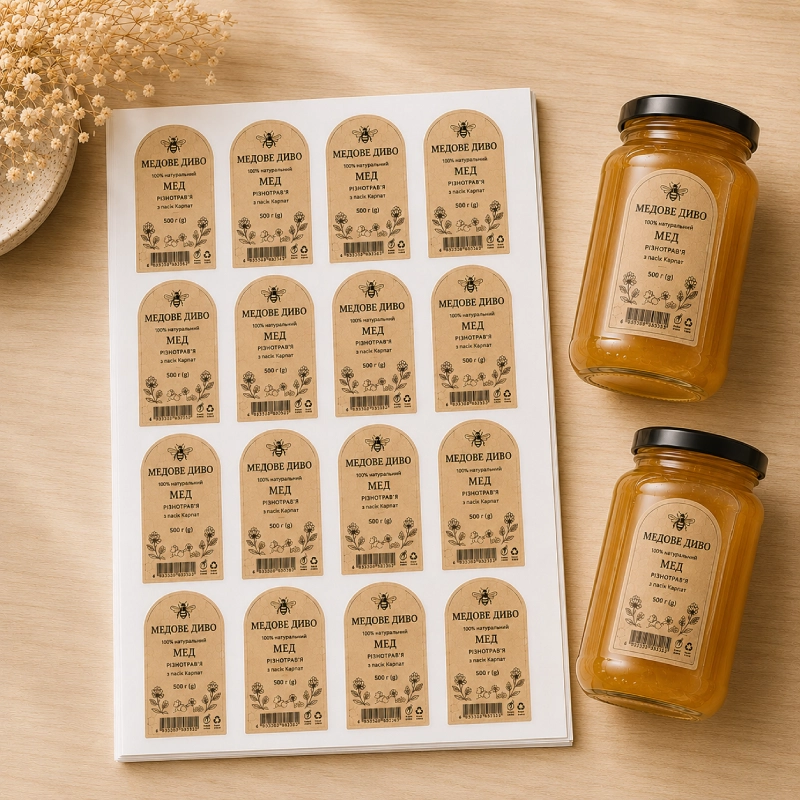
Sheet labels suit beekeepers, small producers and gift editions. The print area of a sheet is 320×450 mm, which fits anything from a few large labels to dozens of small ones, including different designs. Any shape is possible: round, oval or custom. Labels are contour-cut and stay on the backing sheet, so they are easy to peel off and apply by hand. Printing starts from a single sheet, so you can test a new design on a few jars before ordering a batch.
A simple rule of thumb: from about 20 A3 sheets, roll labels become the better deal. They are printed on a web up to 33 cm wide, with a minimum run of 10 linear metres and production from one working day. Rolls work for both hand application and label applicators. Roll labels can carry individual numbering, a packing date, a QR code or barcode, and foil stamping for premium editions.
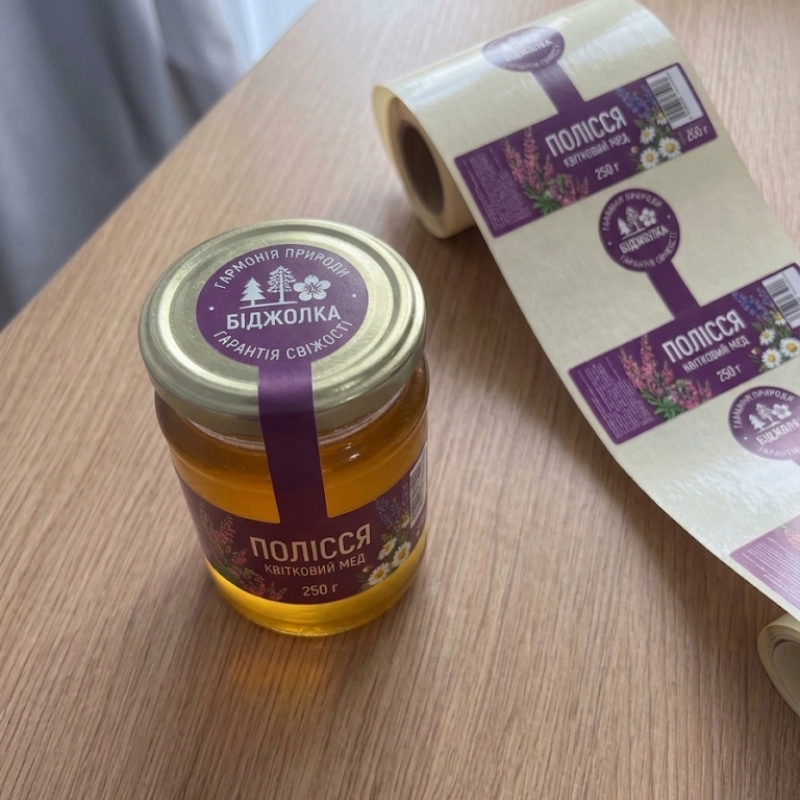
Tamper-evident seal on the lid: protection and trust
A small seal sticker running across the lid and the glass shows the buyer that nobody has opened the jar. For honey sold to customers, it is a simple way to underline that the product is genuine. Seals are best made on film too, so condensation doesn’t turn them soggy.
Label size and shape for your jar
- Height. The label should fit on the flat part of the jar without reaching the shoulders or embossing. It won’t sit flat there and will start to peel.
- Wrap-around labels. The length of a wrap-around label is roughly the jar diameter multiplied by 3.14. Leave a few millimetres of gap so the ends don’t overlap.
- Rounded corners. Even rectangular labels should have corners rounded by at least 1-2 mm: they are much harder to catch and tear off.
- Small jars. For 100-250 ml jars, producers often use two labels: a round one on the lid and a small one on the glass with the name and weight.
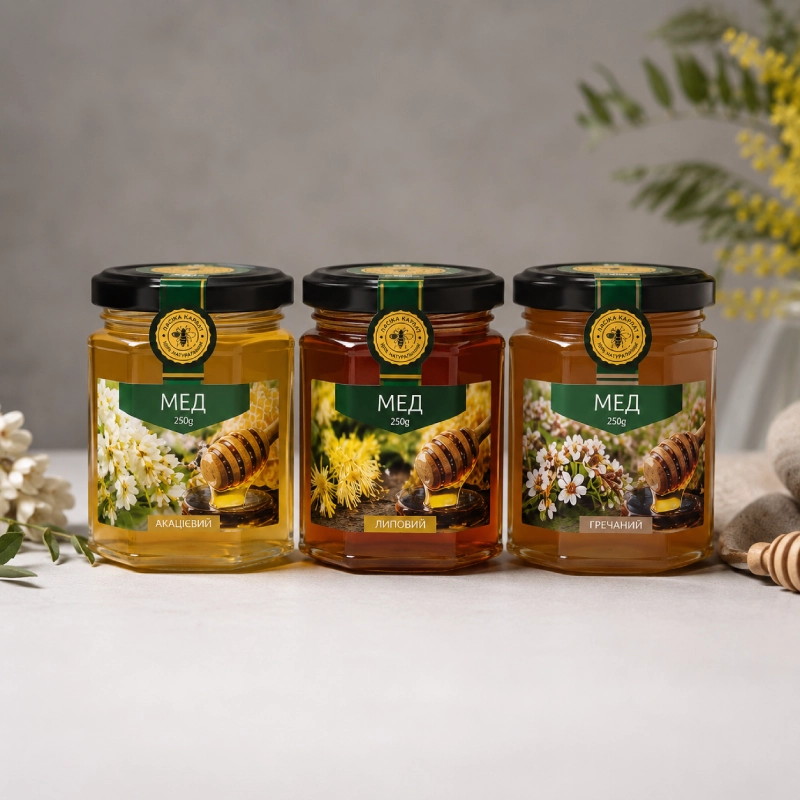
How to apply a label so it stays put
- Clean, dry glass. Wipe the jar with alcohol: traces of grease or honey stop the adhesive from bonding.
- Label preserves after sterilizing. Only on a cooled, completely dry jar. On hot or damp glass, a label won’t hold even if it is film.
- From the centre outwards. Smooth the label from the middle to push out air bubbles.
- Give the adhesive time. After labelling, leave the jars at room temperature for a day before moving them to a cellar or fridge.
Aladdin Print has been printing labels since 2007. If you don’t have a layout yet, our design studio will create one to fit your jar. If you do, we’ll check it before printing. Tell our manager the jar size, storage conditions and quantity, and we’ll recommend a material that won’t let you down.
Frequently asked questions
Can I use a paper label on a honey jar?
Yes, if the honey is stored somewhere dry and the label is laminated. For cellars, fridges and jars that get washed often, film is the better choice.
Which label will survive a cellar and a fridge?
White film, gloss or matte. It resists moisture, condensation and temperature changes. Clear film is moisture-resistant too and works well if the design uses dark colours.
What is the minimum order for jar labels?
Sheet labels are printed from a single sheet, so you can test your design on a small batch. Roll labels are ordered from 10 linear metres.